
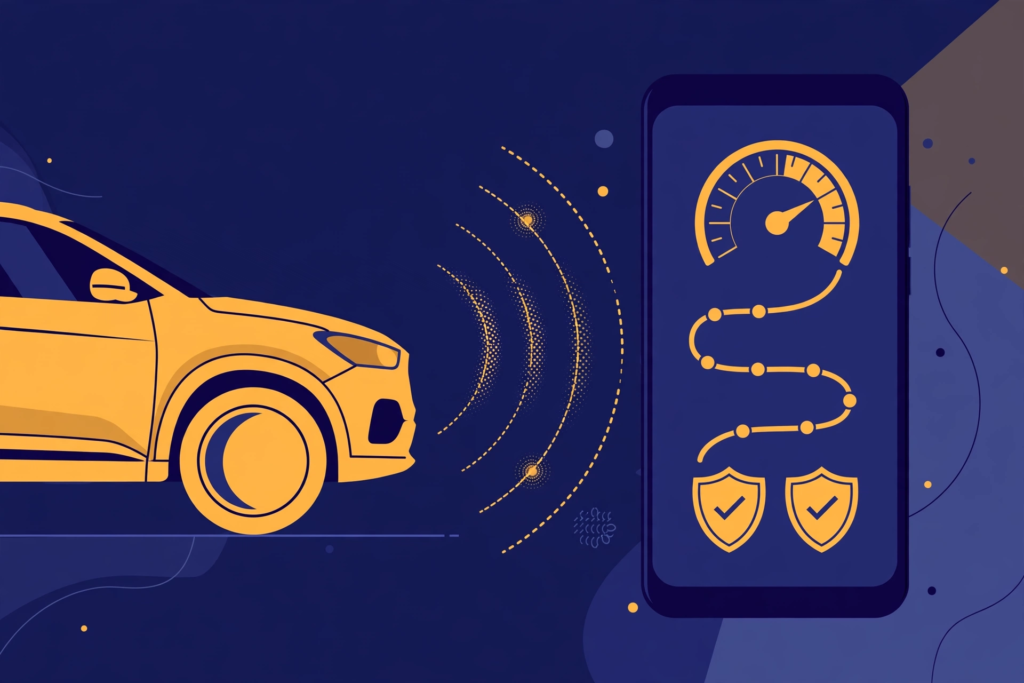
Your driving speaks for itself — and telematics lets your insurer listen. Telematics car insurance apps (also called usage-based or pay-how-you-drive programs) use your smartphone or a plug-in device to measure how you actually drive, then adjust your premium based on the data. Safe drivers can earn significant discounts; aggressive drivers can pay more.
Here’s how these programs work, what they track, how the major types compare, and whether one is right for you.
Telematics car insurance apps at a Glance
Compare telematics car insurance apps: how pay-how-you-drive programs work, what they track, potential savings, and privacy trade-offs. Below, we break down telematics car insurance apps in detail so you can act with confidence.
Table of Contents
What Is Telematics Insurance?
Traditional car insurance prices you based on proxies: your age, ZIP code, credit, vehicle, and driving record. Telematics adds actual behavior to the formula. Instead of guessing your risk from demographic averages, the insurer measures it directly.
Most programs work in two phases:
1. Trial/monitoring period (typically 3–6 months): the app or device collects your driving data
2. Discount application: your premium adjusts based on your driving score — good drivers earn discounts, poor drivers may see increases (program-dependent)
Many insurers also offer an immediate small enrollment discount just for signing up, with the behavior-based discount applied at renewal.
What Do Telematics Apps Track?
While specifics vary, most programs monitor:
- Mileage — how much you drive overall
- Time of day — late-night driving (roughly midnight–4 AM) is riskier and often penalized
- Hard braking — frequent sudden stops suggest tailgating or inattention
- Rapid acceleration — jackrabbit starts correlate with aggressive driving
- Speeding — exceeding posted limits, sometimes measured against GPS speed data
- Cornering — hard turns at speed
- Phone use — some apps detect handling your phone while driving
Each factor feeds a driving score. Smooth, moderate, daytime driving in reasonable amounts scores well; aggressive, high-mileage, late-night driving does not.
How the data is collected
- Smartphone apps — the most common method now; uses your phone’s GPS, accelerometer, and gyroscope. Convenient, but must distinguish your driving from rides as a passenger (most apps let you flag trips).
- Plug-in OBD-II devices — plug into your car’s diagnostic port; very accurate, but require installation and only work in one vehicle
- Built-in vehicle telematics — some programs connect directly to connected-car systems (e.g., GM’s OnStar, Ford’s systems) with your permission
Types of Programs Compared
Traditional insurer telematics (behavior-based discount)
Offered by most major insurers as an optional add-on to a standard policy. You keep your regular policy; telematics adjusts the price.
- Best for: safe drivers with any insurer who want a discount on top of their current policy
- Risk: some programs can raise your rate for poor driving — always check whether the program is discount-only or can surcharge
- Typical savings: safe drivers often earn meaningful discounts, sometimes up to 20–30% depending on the insurer and state
Pay-per-mile programs
Charge a base monthly rate plus a per-mile fee, with behavior sometimes factored in.
- Best for: very low-mileage drivers (under ~7,500 miles/year) — remote workers, retirees, city dwellers with transit options
- Risk: if you drive more than expected, costs can exceed a traditional policy
- Savings: low-mileage drivers can save substantially versus standard policies
Standalone usage-based insurers
Companies built entirely around telematics, where your driving score is the primary rating factor from day one.
- Best for: excellent drivers who want their behavior fully reflected in pricing; younger drivers whose demographics otherwise penalize them
- Risk: poor driving scores mean poor prices — there’s no demographic cushion
- Savings: top-scoring drivers can access some of the lowest rates available
Privacy: What You Should Know
Telematics requires sharing detailed location and behavior data. Before enrolling:
- Read the privacy policy. Understand what data is collected, how long it’s kept, and whether it’s shared with third parties or used for marketing.
- Know it can be used at claim time. Driving data showing you were speeding when an accident occurred could complicate a claim.
- Check deletion options. Ask whether you can delete your data if you leave the program.
- Consider who’s driving. The app typically tracks the phone, not the car — make sure trips as a passenger (or when someone borrows your car) are flagged correctly.
For most participants, the trade-off is worthwhile — but it’s your data, so make it an informed choice.
Who Benefits Most (and Least)
Likely to save:
- Careful, defensive drivers
- Low-mileage drivers
- Daytime drivers with predictable routines
- Young drivers with clean habits (telematics can overcome demographic surcharges)
- Remote workers
May not benefit (or could pay more):
- Frequent late-night drivers (shift workers, nightlife)
- High-mileage commuters
- Aggressive drivers (honest self-assessment matters)
- People uncomfortable sharing location data
- Households where multiple drivers share one phone/app setup messily
Tips for maximizing your score
- Brake early and gently; leave following distance
- Accelerate smoothly
- Observe speed limits (apps often allow small tolerances, but don’t count on it)
- Minimize late-night trips when possible
- Put the phone down — mount it and use hands-free
- Flag passenger trips and non-driving travel promptly
Frequently Asked Questions
Can telematics raise my rates?
It depends on the program. Many are discount-only (worst case: no discount), but some can surcharge poor driving. Always confirm before enrolling — this is the single most important question to ask.
Do I have to keep the app forever?
Most traditional programs require ongoing participation to keep the discount, though some lock in your discount after an initial monitoring period. Pay-per-mile and standalone programs require continuous tracking by design.
What if someone else drives my car?
Phone-based apps track the phone, so another driver using your car without your phone won’t affect your score. But if they drive with your phone in the car, their driving counts — another reason to flag trips accurately.
Will telematics drain my phone battery?
Modern apps are optimized for low battery impact, but continuous GPS does use some power. Most users report minimal noticeable drain.
Can I try telematics without switching insurers?
Yes — most major insurers offer their telematics program as an add-on to existing policies. You can usually try it with your current insurer before deciding whether to shop around.
Is Pay-How-You-Drive Right for You?
If you’re a careful driver, telematics is one of the few discounts based entirely on merit — your actual behavior, not your demographics. The potential savings are real, the enrollment cost is zero, and discount-only programs carry no downside risk. Just read the privacy terms, confirm whether poor scores can raise rates, and drive like someone’s watching — because someone is.
Compare car insurance quotes and ask each insurer about their telematics program — your good driving might be worth more than you think.
For official guidance on telematics car insurance apps, see the Insurance Information Institute. And if this breakdown helped, the related guides below go deeper on telematics car insurance apps saving strategies you can use right away.