
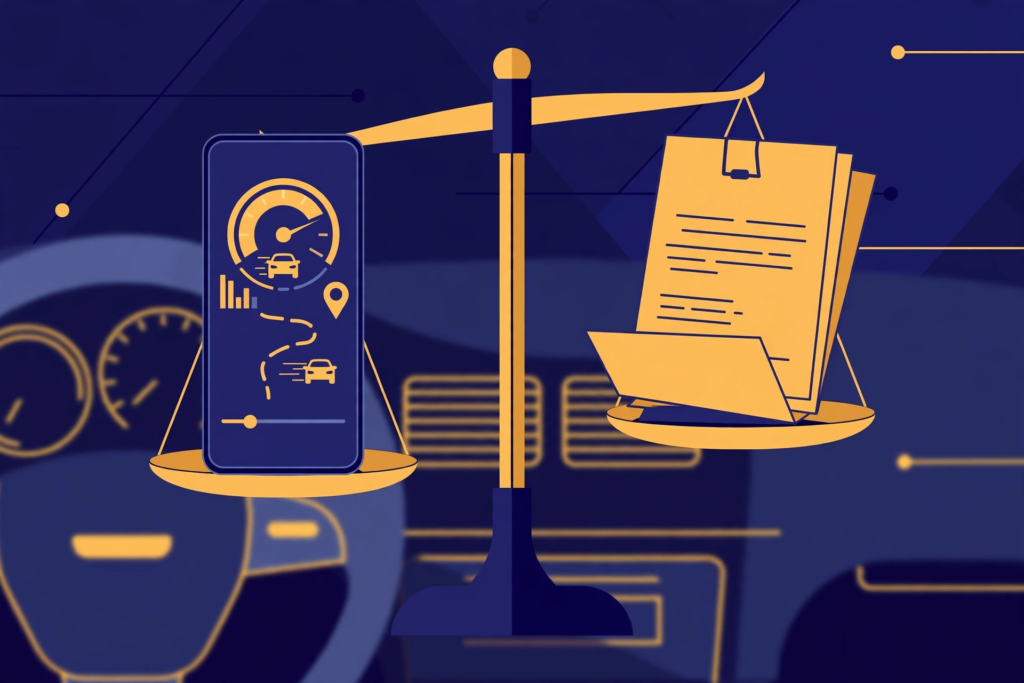
Car insurance has traditionally been priced on who you are — your age, location, vehicle, driving record, and credit-based insurance score. Usage-based insurance flips the model: it prices your policy on how you actually drive, measured by a smartphone app or a plug-in device. So in the matchup of usage based vs traditional insurance, which one is actually cheaper?
The honest answer: it depends on the driver. Safe, low-mileage drivers often save meaningfully with usage-based programs, while aggressive or high-mileage drivers may pay more — or see no benefit at all. This guide breaks down how each model works, who wins under each, and how to decide which is right for you.
Usage based vs traditional insurance at a Glance
Usage based vs traditional insurance: which saves more? Compare telematics pricing, privacy tradeoffs, and which drivers benefit most in 2026. Below, we break down usage based vs traditional insurance in detail so you can act with confidence.
Table of Contents
How Traditional Car Insurance Pricing Works
Traditional auto insurance sets your premium using rating factors — statistical predictors of risk:
- Driving record — accidents, tickets, and violations
- Age and experience — younger drivers pay more
- Location — ZIP code reflects local claim patterns
- Vehicle — repair costs, safety ratings, theft rates
- Credit-based insurance score — used in most states as a risk predictor
- Annual mileage estimate — self-reported, verified loosely if at all
- Coverage choices — limits, deductibles, and add-ons
The key characteristic: traditional pricing is based on groups you belong to, not your individual behavior behind the wheel. A careful driver and a reckless driver with identical demographics and records pay similar rates — the insurer cannot tell them apart.
Strengths of the Traditional Model
- Predictable — your rate does not change based on a bad week of driving
- Private — no app tracking your location, speed, or phone use
- Simple — quote, buy, renew; no enrollment or monitoring period
- No behavioral risk — late-night driving or hard braking never affects your premium
Weaknesses of the Traditional Model
- Safe drivers subsidize risky ones within the same rating groups
- Self-reported mileage is easy to get wrong and rarely verified
- Good driving is not directly rewarded — only the absence of tickets and claims
How Usage-Based Insurance Pricing Works
Usage-based insurance (UBI) — also called telematics insurance — measures your actual driving through a smartphone app, a device plugged into your car’s diagnostic port, or built-in connected-car systems. It typically tracks:
- Mileage — how much you drive
- Speed — including speeding events relative to posted limits
- Braking and acceleration — hard braking and rapid acceleration events
- Time of day — late-night driving is statistically riskier
- Phone use — some apps detect handling the phone while driving
- Cornering — sharp turns in some programs
Your premium is then adjusted based on this data — usually as a discount off a base rate, though some programs can also surcharge for risky driving patterns.
The Enrollment Discount
Most UBI programs offer an immediate participation discount just for signing up — before any driving data is even collected. This makes trying a program low-risk: you save something upfront, and the full discount (or adjustment) applies at renewal based on your measured driving.
Strengths of the Usage-Based Model
- Rewards actual safe driving — careful drivers can earn discounts traditional pricing never offers
- Accurate mileage — low-mileage drivers stop subsidizing high-mileage ones
- Feedback improves driving — many drivers report that the app’s feedback makes them smoother, safer drivers
- Can help high-risk drivers — a driver with a past violation but current safe habits can prove it with data
Weaknesses of the Usage-Based Model
- Privacy tradeoff — the insurer collects detailed location and behavior data
- Risky patterns can raise rates — in some programs, bad scores mean surcharges, not just smaller discounts
- Penalizes unavoidable driving — night-shift workers, for example, may score poorly on time-of-day no matter how safely they drive
- App issues — misclassified trips (as a passenger, on a train) can require manual correction
Head-to-Head: Which Drivers Save with Each?
Drivers Who Usually Save with Usage-Based Insurance
- Low-mileage drivers — remote workers, retirees, second-car owners
- Smooth, cautious drivers — gentle braking, steady speeds, no phone handling
- Daytime drivers — most trips during daylight hours
- Drivers with imperfect records — past tickets but currently safe habits can be demonstrated with data
- Young safe drivers — teens and twenty-somethings with genuinely careful driving can beat their demographic rates
Drivers Who Usually Do Better with Traditional Insurance
- High-mileage drivers — long commutes or road-warriors; mileage is a major UBI factor
- Night drivers — shift workers driving late hours regularly
- Aggressive drivers — if you brake hard and accelerate fast, the data will show it
- Privacy-conscious drivers — if tracking is a dealbreaker, traditional is the only option
- Drivers in areas with bad roads — frequent hard-braking events from traffic or road conditions can hurt scores through no fault of your own
The Privacy Question
UBI requires you to share driving data with your insurer. Programs state that data is used for pricing and not sold, but the details vary by carrier and deserve a careful read of the privacy policy. Consider:
- What data is collected, and how long is it kept?
- Is it shared with third parties or affiliates?
- Can it be used in claim investigations?
- Can you delete your data if you leave the program?
If any answer bothers you, traditional insurance remains a fully viable choice. Savings are not worth discomfort with surveillance for every driver.
How to Decide: A Practical Framework
Step 1: Get a Traditional Baseline
Get quotes for a traditional policy first. This is your comparison point — you need to know what you would pay without telematics.
Step 2: Honestly Assess Your Driving
Be realistic. Do you drive less than average? Brake gently? Avoid late nights and phone use? If yes across the board, UBI is promising. If you drive 20,000 miles a year with a lead foot, traditional pricing probably treats you better.
Step 3: Try a Program with a Trial Period
Many insurers let you do a trial — sometimes through a standalone app — before committing your policy to UBI pricing. Use it. Drive normally for the trial period and see what discount you actually earn. Real data beats speculation.
Step 4: Compare Total Cost, Not Just the Discount
A 20% UBI discount off an expensive base rate can still cost more than a cheaper traditional policy with no discount. Always compare final premiums, including all fees and the participation discount.
Step 5: Re-Evaluate Annually
Driving patterns change. A remote worker who returns to commuting may find UBI suddenly expensive. Re-shop both models at every renewal.
Frequently Asked Questions
Is usage-based insurance actually cheaper than traditional insurance?
For safe, low-mileage drivers, yes — often noticeably so. For high-mileage, night-time, or aggressive drivers, traditional insurance is usually cheaper. The only way to know for sure is to compare real quotes for your situation.
Can usage-based insurance raise my rates?
In most programs, the worst outcome is a small discount rather than a surcharge — but some programs can increase premiums for risky driving data. Read the program terms carefully before enrolling, and prefer programs that promise discounts only.
Does usage-based insurance track my location?
Yes, typically. Telematics apps use GPS to measure mileage, speed relative to limits, and trip patterns. Check the carrier’s privacy policy for details on data retention and sharing.
What if the app records a trip when I was a passenger?
Most apps let you flag trips where you were not the driver, and some attempt automatic detection. Review your trips periodically during the monitoring period to keep your score accurate.
Can I switch back to traditional insurance if I don’t like UBI?
Yes. You can unenroll from a telematics program — usually at renewal, and sometimes mid-term. Your policy reverts to traditional rating. There is generally no penalty for trying and leaving.
The usage based vs traditional insurance debate has no universal winner — only a winner for your driving profile. If you drive little and drive well, telematics can unlock savings that traditional rating never will. If you drive a lot, drive late, or simply value your privacy, traditional pricing remains the better deal.
Compare quotes both ways: get your traditional baseline, then run a telematics trial and compare the real numbers. The cheapest policy is the one priced for the driver you actually are.
For official guidance on usage based vs traditional insurance, see the Insurance Information Institute. And if this breakdown helped, the related guides below go deeper on usage based vs traditional insurance saving strategies you can use right away.