
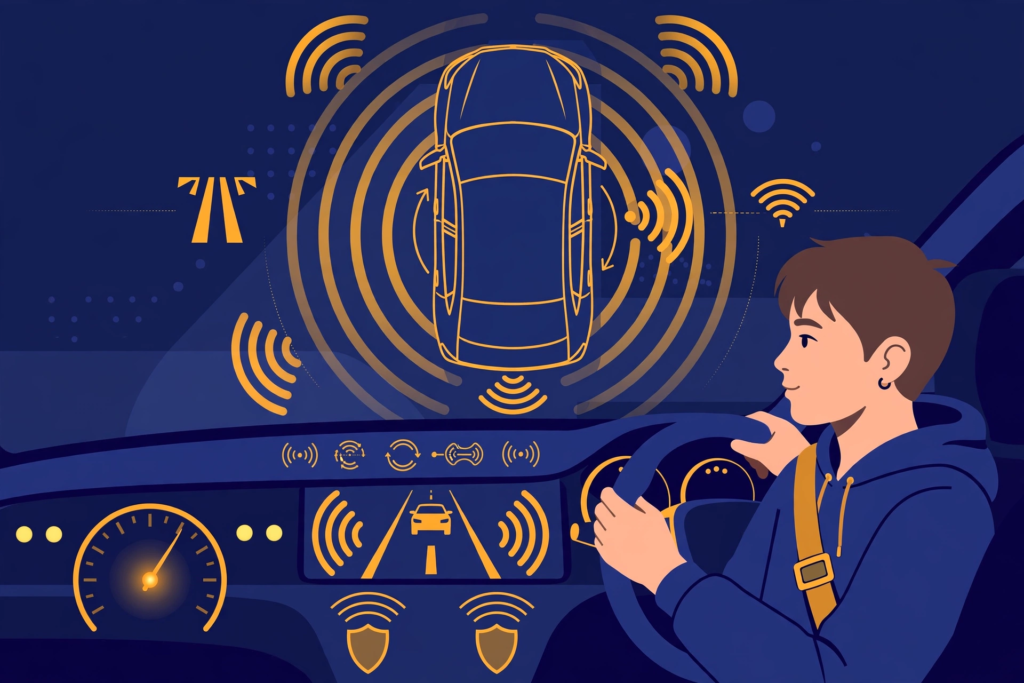
Insuring a teen driver is one of the most expensive milestones in family budgeting. Inexperience plus youthful risk-taking makes teens the costliest drivers to insure — and parents feel it at every renewal. But there is a growing set of tools that can genuinely help: teen driver safety tech insurance discounts and programs that reward safer vehicles, monitored driving, and proven training.
This guide covers the safety technology that matters — in the car, on the phone, and in the driveway — and how each one connects to real insurance savings.
Teen driver safety tech insurance at a Glance
Teen driver safety tech insurance discounts reward safer cars and monitored driving. Learn which features and apps actually lower premiums. Below, we break down teen driver safety tech insurance in detail so you can act with confidence.
Table of Contents
- Teen driver safety tech insurance at a Glance
- Why Insurers Care About Safety Tech for Teens
- Vehicle Safety Features That Earn Discounts
- Telematics and Monitoring Programs
- Driver Education Technology
- The Parent’s Role: Technology Plus Rules
- Other Ways to Lower Teen Insurance Costs
- Frequently Asked Questions
Why Insurers Care About Safety Tech for Teens
Insurers price teen drivers high because the risk is high: teens crash more often and more severely than experienced drivers. Anything that measurably reduces that risk is worth a discount to the insurer — which is why safety technology has become one of the most reliable levers parents have for lowering teen premiums.
Safety tech helps in two ways. Vehicle safety features reduce the likelihood and severity of crashes. Monitoring and feedback tools improve the teen’s actual driving behavior. Insurers discount the first automatically in many cases; the second usually requires enrolling in a specific program.
Vehicle Safety Features That Earn Discounts
When choosing a car for a teen, its safety equipment directly affects the insurance premium. Features that commonly earn discounts or lower base rates include:
Crash Avoidance Technology
- Automatic emergency braking (AEB) — detects impending collisions and brakes automatically; one of the most heavily discounted features
- Forward collision warning — alerts the driver to slow down
- Lane departure warning and lane keeping assist — helps prevent drift-out-of-lane crashes
- Blind spot monitoring — warns of vehicles in blind spots during lane changes
- Rear cross-traffic alert — helps when backing out of driveways and parking spots
- Adaptive cruise control — maintains safe following distance on highways
Crash Protection
- Strong crash-test ratings — vehicles with top ratings from IIHS and NHTSA cost less to insure because injuries are less severe
- Comprehensive airbag systems — side curtain and knee airbags beyond the basics
- Electronic stability control — standard on modern cars, reduces single-vehicle crashes
Teen-Specific Vehicle Settings
Some manufacturers offer teen driver modes — programmable settings that can mute the audio until seatbelts are fastened, set speed alerts or limits, limit audio volume, and generate a report card of the teen’s driving (speeds, distances, safety system interventions). These built-in systems are among the most practical teen safety tools available because they require no extra hardware.
What This Means for Car Choice
A three-year-old sedan with a full suite of driver assistance features will often cost less to insure for a teen than an older car with none — even though the newer car is worth more. When shopping for a teen’s car, get insurance quotes on your finalists before buying. The safety-tech discount can meaningfully offset the higher value of the newer vehicle.
Telematics and Monitoring Programs
Beyond the car’s built-in features, telematics programs — smartphone apps or plug-in devices that monitor driving — are increasingly central to teen driver safety tech insurance savings.
How They Work for Teens
The app or device tracks speed, braking, acceleration, phone use, time of day, and mileage. Parents typically get a dashboard or weekly report; the insurer uses the data to calculate a discount. Many programs offer an upfront enrollment discount plus a behavior-based discount at renewal.
Why Teens Benefit Disproportionately
Teens start from the highest base rates, so a percentage discount saves more dollars for a teen than for an adult. A program that earns a moderate discount can cut hundreds off a teen’s annual premium — savings that are harder to achieve through any other single action.
The Accountability Effect
Parents consistently report that monitored teens drive more carefully — the awareness of being tracked changes behavior. Even setting the insurance discount aside, the safety improvement is the real prize. Some families use monitoring for the first year or two of licensure, then graduate to unmonitored driving once habits are established.
Choosing a Program
- Prefer programs that offer discounts only (no surcharges for bad scores) while your teen is learning
- Check whether the program distinguishes driver from passenger trips
- Look for programs with parent dashboards and real-time alerts for serious events like excessive speeding
- Compare the total premium with and without the program — a big telematics discount off an expensive base rate can still lose to a cheaper carrier
Driver Education Technology
Online and In-Person Driver’s Ed
Completing an approved driver’s education course still earns discounts with many insurers and, more importantly, builds foundational skills. Some states allow online driver’s ed; check that your insurer recognizes the specific program before enrolling for the discount.
Defensive Driving Courses
A defensive driving or advanced skills course taken after licensure can earn an additional discount with some carriers and genuinely improves hazard awareness. Weekend advanced driving schools that teach skid control and emergency maneuvers are a worthwhile investment for new drivers.
Simulation and Practice Apps
Driving simulators and hazard-perception training apps are emerging tools that build scanning and decision skills without real-world risk. While insurers do not typically discount these directly yet, the skill improvement supports the safe driving record that earns long-term discounts.
The Parent’s Role: Technology Plus Rules
Safety tech works best combined with clear family driving rules. Consider a written parent-teen driving agreement covering:
- No phone use while driving (use Do Not Disturb While Driving modes)
- Passenger limits during the first year
- Nighttime driving restrictions
- Zero tolerance for alcohol
- Consequences for tickets or at-fault incidents
Pair the agreement with the monitoring tech: the app provides the data, the agreement provides the consequences. Teens who know their driving is both measured and tied to clear rules develop safer habits faster.
Other Ways to Lower Teen Insurance Costs
Safety tech is powerful, but it works best stacked with the classic teen discounts:
- Good student discount — strong grades earn one of the largest teen discounts available
- Student away at school discount — if the teen attends school far from home without a car
- Higher deductibles — raising collision and comprehensive deductibles lowers premiums
- The right car — safe, modest, and not sporty; avoid high-performance vehicles entirely
- Shopping annually — teen rates vary enormously between carriers; never auto-renew without comparing
Frequently Asked Questions
Does safety technology actually lower teen car insurance?
Yes. Vehicles with advanced driver assistance features (automatic emergency braking, blind spot monitoring, lane keeping) typically earn safety discounts or lower base rates, and telematics monitoring programs offer behavior-based discounts that are especially valuable given teens’ high starting premiums.
What is teen driver mode?
Teen driver mode is a built-in vehicle feature offered by some manufacturers that lets parents set speed alerts or limits, mute audio until seatbelts are buckled, limit volume, and receive a report card of driving events. It requires no extra hardware and is one of the most practical teen safety tools.
Are telematics apps worth it for teen drivers?
Often yes. Because teen base rates are so high, even a moderate telematics discount saves significant money. Programs with discounts-only scoring (no surcharges) are the safest choice while a teen is still learning.
Will a newer car with safety tech cost more to insure for my teen?
Not necessarily. The higher vehicle value raises collision and comprehensive costs, but safety-tech discounts and better crash ratings often offset much of that. Always get quotes on specific vehicles before buying — the results surprise many parents.
Do good grades still matter for teen insurance discounts?
Yes. The good student discount remains one of the largest available discounts for teen drivers and stacks with safety-tech and telematics discounts. A B average or better is the typical threshold.
Teen driver safety tech insurance savings are real, but the deeper win is the safety itself. A monitored teen in a car full of driver assistance features is genuinely less likely to crash — which protects your child first and your premium second.
Compare quotes with your teen’s specific vehicle and a telematics program factored in, stack every discount you qualify for, and re-shop every year. Teen rates fall as experience grows, and the family that shops actively pays far less over the high-school and college years.
Want the full picture on teen driver safety tech insurance? Start with the National Association of Insurance Commissioners for the official rules, then work through the related guides below for practical teen driver safety tech insurance money-saving steps.