
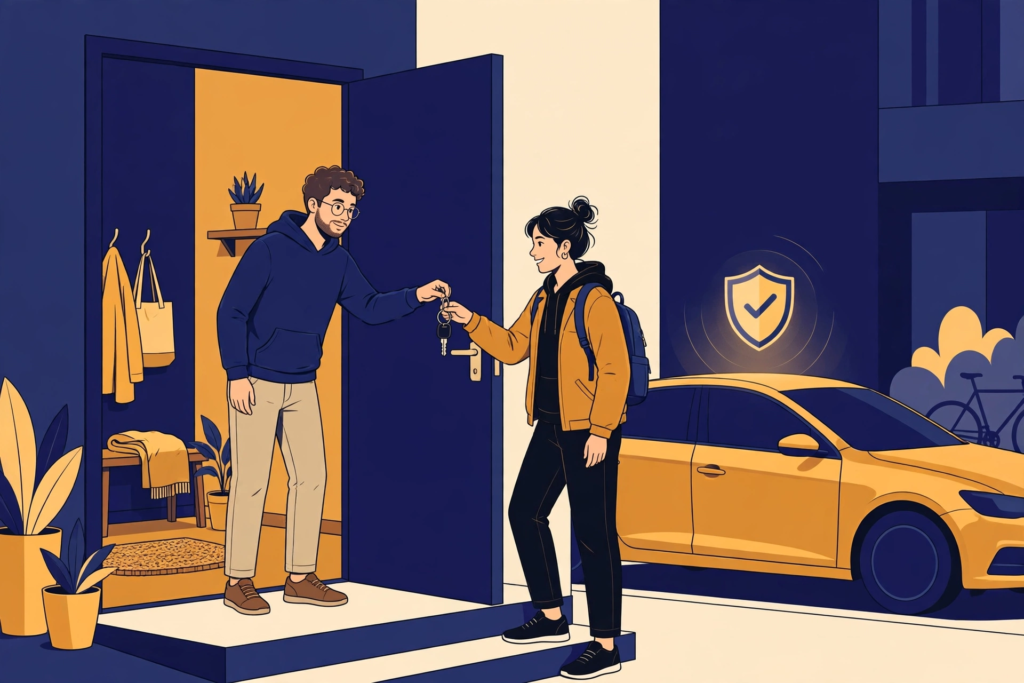
Roommate life comes with shared kitchens, split bills, and — sooner or later — the question of the car. “Can I borrow your car to grab groceries?” It feels harmless. But when a roommate borrowing car insurance questions come up after an accident, the answers are less casual than the arrangement. Whether your policy covers your roommate depends on how often they drive your car, what your policy says about unlisted drivers, and whether your insurer considers them a household member.
This guide covers the rules so a favor between roommates does not turn into a denied claim or a damaged friendship.
Roommate borrowing car insurance at a Glance
Roommate borrowing car insurance questions answered: permissive use, listed drivers, and what happens when your roommate crashes your car. Below, we break down roommate borrowing car insurance in detail so you can act with confidence.
Table of Contents
Permissive Use: The Occasional Borrow
Most personal auto policies cover permissive use — when someone drives your car with your permission. If your roommate borrows your car once in a while for an errand and has your clear permission, your policy’s liability and physical damage coverage generally extends to them, just as it would for any permissive driver.
Key points about permissive use:
- Permission matters. Express permission (“yes, take my car”) is cleanest. Implied permission (they have borrowed it before without objection) usually counts too, but it is murkier. Never let someone drive your car who you have told not to — that can void coverage.
- Their record does not have to be perfect. Your policy covers the permissive driver, though a serious accident will still affect your policy and premiums.
- Coverage follows the car first. Your policy is primary when your car is involved; the driver’s own policy (if they have one) is typically excess.
What “Occasional” Really Means
Permissive use is designed for infrequent borrowing — a few times a month at most. There is no universal numerical threshold, but insurers and courts look at the pattern. If your roommate drives your car every day to work, that is not occasional borrowing. That is regular use, and it changes everything.
When Your Roommate Becomes a Regular Driver
If your roommate drives your car regularly, most insurers require them to be listed as a driver on your policy. Regular use without listing is one of the most common reasons claims get investigated — and sometimes denied — under the concept of material misrepresentation: the insurer rated your policy for one driver, but the real risk included two.
Are Roommates Considered Household Members?
This is where it gets tricky. Many policies require all licensed household members to be listed or excluded. Whether a roommate counts as a household member depends on the policy language and the state. Some insurers define household members narrowly (relatives); others define it broadly (anyone living under the same roof).
Do not guess. Read your policy’s definition of household member, or ask your agent directly: “My roommate lives with me — do they need to be listed?” The answer determines your obligations.
The Cost of Adding a Roommate
Adding a roommate as a listed driver will change your premium — how much depends on their age, driving record, and how much they drive. A clean-record adult roommate may add only a modest amount; a young or violation-prone driver can add a lot. This is a fair thing to split: if they drive your car regularly, they should share the insurance cost.
Excluded Drivers: The Nuclear Option
If your roommate has a terrible driving record and you do not want their risk (and cost) on your policy, most insurers allow you to exclude them as a driver. An excluded driver has no coverage under your policy — period. If they drive your car and crash, the claim is denied.
Exclusion is a legitimate tool, but it comes with a hard rule: the excluded person must not drive the car. Not in emergencies, not “just this once.” If you exclude your roommate, take the keys seriously. Some states restrict exclusions or require specific forms, so check your state’s rules.
What Happens If Your Roommate Crashes Your Car
If They Were a Permissive, Occasional Driver
Your policy responds: liability for damage they cause to others, and collision/comprehensive for damage to your car (minus your deductible). Expect your premiums to increase at renewal — the accident goes on your policy’s record even though your roommate was driving.
If They Were an Unlisted Regular Driver
This is the danger zone. The insurer may:
- Pay the claim but then raise your rates substantially or non-renew your policy
- Investigate whether you misrepresented the household’s drivers when you applied
- In serious cases, attempt to deny the claim based on material misrepresentation
Outcomes vary by state law and policy language, but none of them are good. This is the scenario the “just list them” advice is designed to prevent.
If They Were Excluded
The claim is denied. You are personally on the hook for damage to your own car, and your liability exposure for damage to others depends on state law — in some states, the owner’s liability still attaches. Never let an excluded driver behind the wheel.
Practical Rules for Roommates and Cars
Have the Conversation Early
Before the borrowing starts, agree on ground rules:
- How often can they borrow the car, and for what purposes?
- Who pays for gas, and what happens if they get a ticket or cause damage?
- Will they be added to your policy if borrowing becomes regular?
Notify Your Insurer When Patterns Change
If occasional borrowing becomes a regular arrangement, call your agent. Adding a driver mid-policy is routine, and the premium adjustment is prorated. A five-minute phone call now beats a coverage fight later.
Consider the Roommate’s Own Policy
If your roommate has their own car and policy, their policy typically acts as excess coverage when they drive your car. If they have a non-owner policy, that can also provide a backstop. Ask whether they carry their own insurance — it is a reasonable question between people sharing a home.
Document Permission
For regular arrangements, a simple written agreement — even a text message thread — confirming permission and cost-sharing is useful. It will not override policy terms, but it eliminates “I thought I couldn’t drive it” disputes.
Frequently Asked Questions
Does my car insurance cover my roommate if they borrow my car?
If the borrowing is occasional and you gave permission, yes — permissive use coverage typically applies. If your roommate drives your car regularly, they generally need to be listed as a driver on your policy.
Do I have to list my roommate on my car insurance?
It depends on your policy and state. Many policies require all licensed household members to be listed or excluded, and some insurers count roommates as household members. Ask your agent how your policy defines household members.
What happens if my unlisted roommate crashes my car?
Your insurer may still pay the claim, but you risk significant rate increases, non-renewal, or a misrepresentation investigation. If the roommate was formally excluded, the claim will be denied.
Can I exclude my roommate from my policy?
In most states, yes. An excluded driver has no coverage under your policy, which keeps their risk off your premium — but they must never drive your car, or claims will be denied.
Should my roommate pay part of my insurance?
If they drive your car regularly and are listed on your policy, splitting the added cost is fair and common. Even for occasional borrowing, many roommates agree to cover gas and chip in if their use contributes to a rate increase.
Roommate car-sharing works fine when the insurance matches the reality. Occasional, permitted borrowing is covered. Regular driving requires a listed driver. And a roommate who should never drive the car should be formally excluded — with the keys kept out of reach.
Compare quotes with your roommate listed versus excluded to see the real cost difference, and put your arrangement in writing. The cheapest insurance outcome is the one where everyone knows the rules before the keys change hands.
Rules and rates change, so double-check the details of roommate borrowing car insurance with the National Association of Insurance Commissioners. For more ways to save, keep reading the guides linked below.
Shopping for roommate borrowing car insurance? Start by comparing quotes from at least three insurers — drivers who compare save significantly on roommate borrowing car insurance every year.