
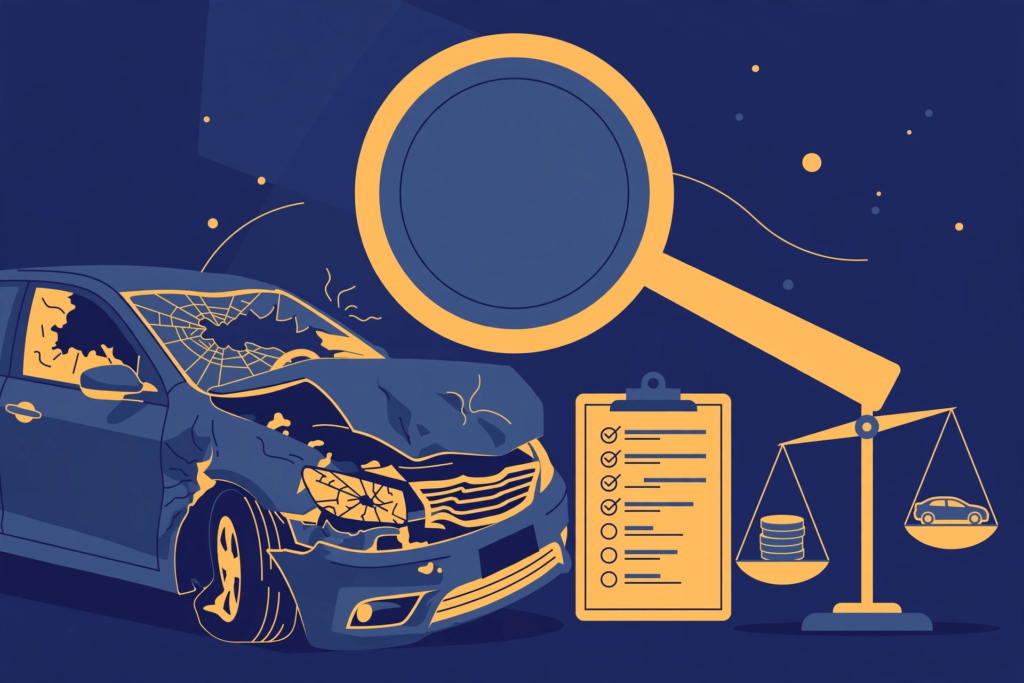
Hearing your car is a “total loss” after an accident is stressful enough — but the real shock often comes next, when the insurer tells you what they think your car was worth. Understanding how total loss car value is determined puts you in a much stronger position to make sure the payout is fair. Insurers do not pull numbers out of thin air, but their valuation methods do not always favor you, either.
Here is how the total loss process works, how insurers calculate your car’s value, and what to do if you disagree with their number.
Total loss car value at a Glance
How do insurers determine total loss car value? Learn the total loss threshold, ACV explained, and how to negotiate a fair payout. Below, we break down total loss car value in detail so you can act with confidence.
Table of Contents
What Does “Total Loss” Mean?
A car is declared a total loss when the cost to repair it exceeds a certain percentage of its value — or when it is damaged so severely that safe repair is not possible. This is not a judgment about whether the car could theoretically be fixed; it is a financial decision.
The Total Loss Threshold
Each state sets a total loss threshold, typically expressed as a percentage of the car’s actual cash value (ACV). Common thresholds range from around 60% to 100%:
- If repairs would cost more than the threshold percentage of the car’s value, the insurer declares it a total loss
- Some states use a total loss formula: if repair cost plus salvage value exceeds the car’s ACV, it is totaled
For example, if your car’s ACV is $15,000 and your state has a 75% threshold, repair estimates above $11,250 would trigger a total loss declaration.
Actual Cash Value (ACV) Explained
ACV is the cornerstone of total loss valuation. It means what your car was worth immediately before the accident — not what you paid for it, not what you owe on it, and not what a new one costs. ACV accounts for:
- Age, mileage, and overall condition
- Trim level and factory options
- Regional market prices for comparable vehicles
- Pre-existing damage or wear
Depreciation is the reason ACV surprises people: a car you bought for $28,000 three years ago might have an ACV of only $16,000 today.
How Insurers Calculate Your Car’s Value
When your car is totaled, the adjuster does not just guess. Insurers typically use one or more of these methods:
Third-Party Valuation Reports
Most insurers use valuation services that pull data on comparable vehicles recently sold or listed in your area. These reports adjust for your car’s specific mileage, condition, trim, and options. Ask your adjuster for a copy of the valuation report — you are entitled to see how they reached their number.
Comparable Listings
You can (and should) do your own homework: search for your exact year, make, model, trim, and similar mileage within a reasonable distance. Dealer retail listings, private-party ads, and pricing guides all help establish what your car was really worth.
Adjustments and Deductions
Insurers adjust the baseline value for your car’s specific condition. Be aware of deductions for:
- Prior unrepaired damage
- Excessive wear, stains, or mechanical issues
- Missing features compared to the “typical” comparable
Review every deduction critically. If the report claims your tires were worn or your interior was below average and that is not accurate, challenge it with photos or maintenance records.
The Total Loss Settlement Process
Step 1: The Inspection and Declaration
After the accident, the insurer inspects the damage and runs the numbers against your state’s threshold. You will be notified that the vehicle is a total loss.
Step 2: The Valuation
The adjuster prepares the ACV valuation. This is where you should be proactive: provide maintenance records, receipts for recent upgrades (new tires, major services), and your own comparable listings.
Step 3: Review the Offer
The insurer presents a settlement offer based on the ACV, minus your deductible (if it is your own collision coverage) and minus any prior payments. Review the valuation report line by line.
Step 4: Negotiate If Needed
If the offer is low, counter with evidence: better comparables, documentation of your car’s excellent condition, receipts for improvements. Negotiation is a normal part of the process.
Step 5: Settle and Transfer the Title
Once you agree, you sign the title over to the insurer, and they issue payment. If you have a loan, the lender gets paid first, and you receive any remainder. If you owe more than the ACV — being “upside down” — gap insurance covers the difference if you have it.
What If You Owe More Than the Car Is Worth?
This is one of the most painful total loss scenarios. Because cars depreciate faster than loans amortize, many drivers owe more than their car’s ACV — especially in the first few years of a loan. Your options:
- Gap insurance pays the difference between the ACV payout and your loan balance. If you have it, this situation is handled.
- Without gap insurance, you are responsible for the remaining loan balance out of pocket. This is why gap coverage is strongly recommended for financed and leased vehicles.
Can You Keep a Totaled Car?
In many states, yes — you can sometimes keep the vehicle and accept a reduced settlement (the ACV minus the car’s salvage value). Considerations:
- The car will receive a salvage title, which drastically reduces its resale value and can make insurance harder to get
- It must pass state inspections to be rebuilt and re-titled for road use
- Lenders generally will not allow this on financed vehicles
Keeping a totaled car occasionally makes sense for rare or sentimental vehicles, but for most drivers, taking the full settlement is the better financial move.
Frequently Asked Questions
How do insurance companies determine total loss value?
They calculate your car’s actual cash value (ACV) — its fair market value just before the accident — using valuation reports based on comparable vehicles, adjusted for mileage, condition, trim, and options. The settlement offer is based on that ACV.
Can I negotiate a total loss settlement?
Absolutely. Provide your own comparable listings, maintenance records, and receipts for recent improvements. Point out errors in the insurer’s valuation report, such as wrong trim levels or unjustified condition deductions. Many drivers successfully increase their initial offers.
What happens if I still owe money on a totaled car?
The insurer pays the lender first up to the ACV amount. If the ACV covers the loan, you get any remainder. If you owe more than the ACV, gap insurance covers the shortfall — without it, you owe the difference out of pocket.
Does my deductible apply to a total loss claim?
Yes, if the claim is under your own collision or comprehensive coverage, your deductible is subtracted from the payout. If you are claiming against the at-fault driver’s liability coverage, there is no deductible.
How long does a total loss settlement take?
Straightforward cases often settle within a couple of weeks once the valuation is complete. Disputes over value, loan payoff complications, or title issues can extend the timeline. Staying responsive and organized speeds things up.
The Bottom Line
A total loss does not have to mean a bad deal — but it does require you to be an active participant. Understand ACV, review the valuation report, gather your own comparables, and negotiate when the numbers do not add up. And take this as a reminder to review your policy: gap insurance for financed cars, sensible deductibles, and rental reimbursement all matter enormously when a car is totaled. Compare quotes from several insurers to make sure your coverage — and your insurer’s claims reputation — will be there when you need them most.
Rules and rates change, so double-check the details of total loss car value with the Insurance Information Institute’s claims guide. For more ways to save, keep reading the guides linked below.
Shopping for total loss car value? Start by comparing quotes from at least three insurers — drivers who compare save significantly on total loss car value every year.