
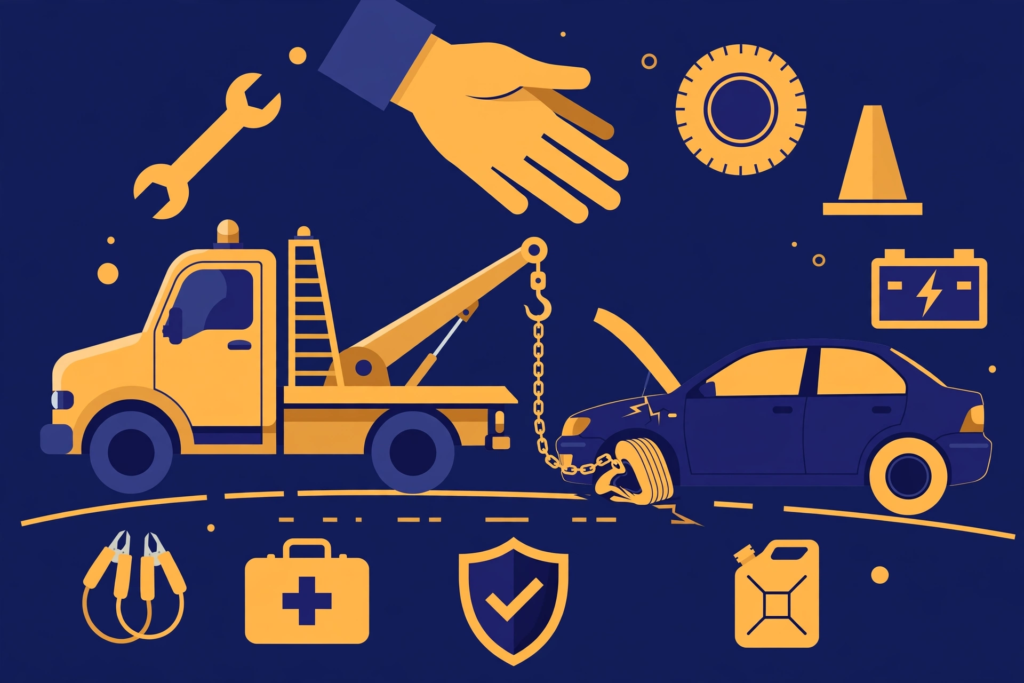
A dead battery in a dark parking lot. A flat tire on the highway shoulder. Keys locked inside at the gas station. These small emergencies happen to nearly every driver eventually — and roadside assistance coverage is the inexpensive add-on that sends help with one phone call. Here’s what it typically includes, what it costs, how it compares to motor clubs, and whether it belongs on your policy.
What Roadside Assistance Coverage Is
Roadside assistance is an optional add-on to your auto insurance policy that provides emergency services when your car becomes disabled. Instead of scrambling to find and pay a tow company yourself, you call your insurer’s roadside hotline (or request help through their app), and they dispatch a service provider — with the covered costs billed to the policy.
Roadside assistance coverage at a Glance
What does roadside assistance coverage include? Towing, jump starts, lockouts and more — learn how it works and if it’s worth it. Below, we break down roadside assistance coverage in detail so you can act with confidence.
Table of Contents
It’s distinct from towing-and-labor coverage in name only in some cases; many insurers use the terms interchangeably, while others sell them as slightly different products. The practical question is always the same: what’s included, and what are the limits?
What’s Typically Included
Most roadside assistance add-ons cover a standard set of emergencies:
- Towing — to the nearest qualified repair facility, usually up to a mileage limit (commonly 15–25 miles; some policies offer extended towing)
- Jump starts — for dead batteries
- Flat tire changes — swapping on your inflated spare (or towing you if there’s no usable spare)
- Lockout service — unlocking your car when keys are inside (usually up to a set dollar amount per occurrence)
- Fuel delivery — enough gas to reach the nearest station if you run dry (you pay for the fuel itself)
- Winching / extrication — pulling your car out of mud, snow, or a ditch, typically when it’s accessible from the road
Each service usually has per-occurrence limits, and policies often cap the number of service calls per term (commonly 3–4). Exceed the cap and you’re paying out of pocket or waiting for renewal.
What It Usually Doesn’t Cover
- The underlying repair. Roadside gets you *to* the shop; fixing the car is a separate matter (and a separate coverage).
- Towing beyond the mileage limit. Long-distance tows can leave you paying the overage.
- Repeated calls for the same unresolved problem. If your battery keeps dying because you won’t replace it, expect pushback.
- Off-road recovery. Stuck far from a maintained road is typically excluded.
- Non-emergency towing. Moving a project car or transporting a vehicle you just bought isn’t covered.
What It Costs
Roadside assistance through your auto insurer is typically very inexpensive — often just a few dollars per vehicle per policy term. That low price is the main argument for it: a single tow at retail rates can cost many times the annual premium for the coverage.
Be aware of one nuance: some insurers treat roadside assistance claims as claims history. A handful of service calls are normal, but a pattern of frequent use could theoretically affect pricing or renewal with certain carriers. Using it for genuine emergencies a couple of times a year is what it’s for — just don’t treat it as a maintenance plan.
Roadside Assistance vs Motor Clubs
The alternative most drivers know is a motor club membership (like AAA). How do they compare?
- Cost. Insurer roadside add-ons are usually cheaper than a standalone motor club membership.
- Coverage scope. Motor clubs often include longer towing distances, trip-interruption benefits, travel discounts, and coverage that follows *you* in any car — insurer roadside typically covers *your insured vehicles*.
- Service network. Both dispatch local providers; quality varies more by area than by brand.
- Bundled perks. Motor clubs bundle travel, DMV, and discount services that insurance add-ons don’t.
If you want the cheapest emergency safety net for your own cars, the insurance add-on usually wins. If you want member perks, longer tows, and coverage in any vehicle (including rentals), a motor club may justify its higher price. Some drivers carry both — the add-on for daily driving and the club for road trips.
Who Benefits Most
Roadside assistance makes the most sense if:
- You drive an older car. Higher breakdown risk means higher expected value from the coverage.
- You commute or drive long distances. More miles mean more exposure to flats, dead batteries, and empty tanks.
- You have teen drivers. New drivers are the most likely to lock keys in cars and run out of gas — and the least equipped to handle it alone.
- You travel rural areas. Being stranded far from town without a plan is genuinely dangerous; one call for help is worth the premium.
- You’d rather not comparison-shop tow trucks at midnight. The convenience factor alone justifies a few dollars.
If you drive a brand-new car with manufacturer roadside assistance included (many new cars include several years), check for overlap before paying twice.
Frequently Asked Questions
What does roadside assistance coverage include?
Typically towing to the nearest repair shop (up to a mileage limit), jump starts, flat tire changes, lockout service, emergency fuel delivery, and winching — each subject to per-occurrence limits and a cap on service calls per term.
Is roadside assistance through insurance worth it?
For most drivers, yes — it’s very inexpensive, and one tow can cost several times the annual premium. It’s especially valuable for older cars, long commutes, teen drivers, and rural driving.
Will using roadside assistance raise my rates?
Occasional use for genuine emergencies is normal and generally not a problem. However, some insurers track service calls, and excessive use could affect pricing or renewal with certain carriers — it’s meant for emergencies, not routine maintenance.
What’s the difference between roadside assistance and towing coverage?
The terms are often used interchangeably. Some insurers sell “towing and labor” as a narrower product focused on tows and on-site labor, while “roadside assistance” bundles the fuller set of services. Compare the included services, not just the name.
Does it cover me in a rental car or someone else’s car?
Usually no — insurer roadside assistance typically covers your listed insured vehicles. Motor club memberships more commonly follow the person. Check your policy’s terms before relying on it away from your own car.
The Bottom Line
Roadside assistance coverage is a few dollars of genuine peace of mind: one call turns a dead battery, flat tire, or lockout from a crisis into an inconvenience. It’s cheapest through your auto insurer, most valuable for older cars and high-mileage drivers, and worth comparing against motor club memberships if you want broader perks. Add it to your next round of quotes, confirm the towing mileage and service-call limits, and drive knowing that the next small emergency already has a plan.
Rules and rates change, so double-check the details of roadside assistance coverage with the Insurance Information Institute’s coverage guide. For more ways to save, keep reading the guides linked below.