
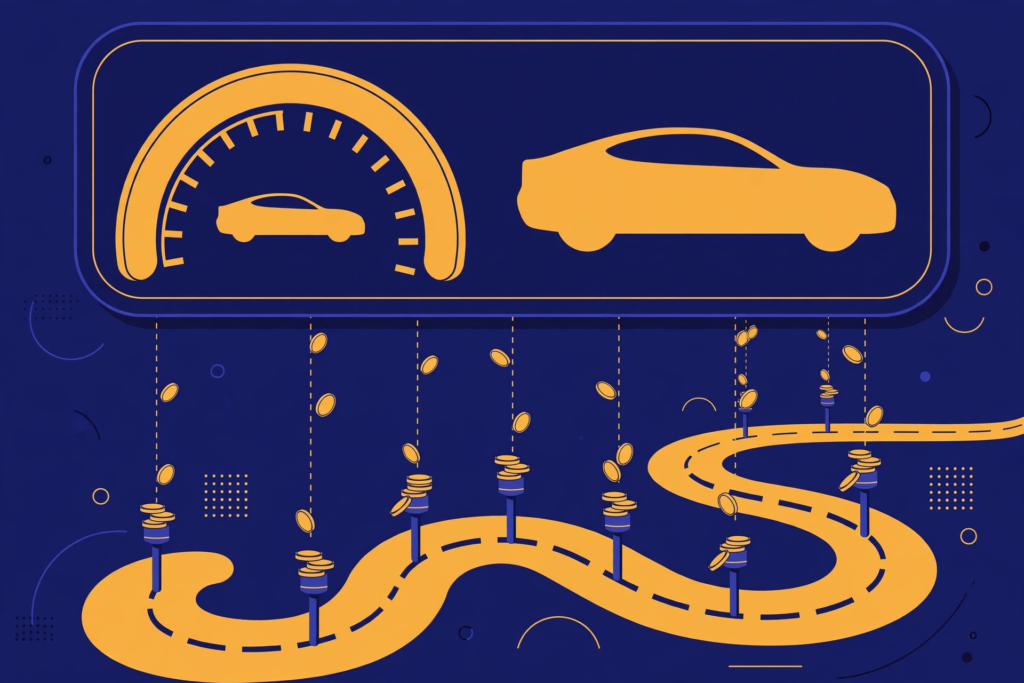
Pay per mile car insurance flips the traditional pricing model on its head: instead of paying a flat premium based on estimated risk factors, you pay a low base rate plus a per-mile charge for every mile you actually drive. For low-mileage drivers, the savings can be dramatic — which is why this model has grown from a niche experiment into a mainstream option in 2026.
But pay-per-mile is not automatically cheaper for everyone. How it works, how miles are tracked, and where the breakeven point sits against traditional policies all determine whether it fits your driving life. This deep dive covers the mechanics, the math, and the tradeoffs.
Pay per mile car insurance at a Glance
Pay per mile car insurance deep dive: how it works, who saves the most, real costs, telematics, and whether it’s cheaper than traditional policies. Below, we break down pay per mile car insurance in detail so you can act with confidence.
Table of Contents
- Pay per mile car insurance at a Glance
- How Pay-Per-Mile Insurance Works
- How Miles Are Tracked
- Who Saves the Most with Pay-Per-Mile
- Pay-Per-Mile vs Traditional Insurance: The Math
- Coverage Options and Limitations
- Privacy Considerations
- Tips for Getting the Most from Pay-Per-Mile
- Frequently Asked Questions
How Pay-Per-Mile Insurance Works
The pricing structure has two components. The base rate is a fixed monthly charge — typically modest — that covers the car while it is parked, including risks like theft, weather, and vandalism. The per-mile rate is a cents-per-mile charge that applies to every mile driven, covering the on-road risk.
Your monthly bill is simply base rate plus (miles driven × per-mile rate). Drive 300 miles in a month and you pay for 300 miles; drive 2,000 and you pay for 2,000. Most programs cap the daily or monthly billable miles, so a single long road trip does not produce a shocking bill — once you hit the cap, additional miles that period are effectively free.
Both rates are personalized using traditional factors — your driving record, vehicle, location, and sometimes credit-based insurance scores where allowed — so two drivers with identical mileage can pay different per-mile rates.
How Miles Are Tracked
Accurate mileage measurement is the foundation of the model, and insurers use a few methods:
- Plug-in telematics devices. A small device in the car’s OBD-II port records mileage (and sometimes driving behavior). Simple and reliable for most 1996-and-newer vehicles.
- Smartphone apps. Your phone’s GPS tracks driving automatically. Convenient, but accuracy depends on the phone being present and charged during every trip.
- Built-in car telematics. Some insurers connect directly to connected-car systems, eliminating extra hardware entirely.
- Odometer photos. A few programs verify mileage with periodic odometer photos — low-tech but effective, and appealing to privacy-conscious drivers.
Each method has tradeoffs between convenience, accuracy, and privacy. If you are uncomfortable with location tracking, look for programs that measure mileage only, without recording where you went or how you drove.
Who Saves the Most with Pay-Per-Mile
The ideal pay-per-mile customer drives significantly less than average. Strong candidates include:
- Remote workers who rarely commute.
- Retirees whose driving is mostly local errands.
- City dwellers who use transit, biking, or walking for daily needs and keep a car for weekends.
- Two-car households where one vehicle is a lightly used second car.
- Seasonal drivers whose cars sit for months at a time.
The general rule of thumb: drivers well below average annual mileage tend to save, while drivers at or above average usually pay more than they would on a traditional policy. Your personal breakeven point depends on the specific base and per-mile rates you are quoted — always compare against a traditional quote with identical coverage.
Pay-Per-Mile vs Traditional Insurance: The Math
To decide, you need three numbers: the pay-per-mile base rate, the per-mile rate, and a traditional policy quote for the same coverage. The breakeven mileage is roughly (traditional premium − base rate) ÷ per-mile rate, adjusted for any mileage caps.
Worked conceptually: if a traditional policy costs a certain amount per month, and the pay-per-mile program charges a base rate plus a per-mile fee, then driving fewer miles than the breakeven point saves money and driving more costs extra. Because rates vary enormously by driver profile and state, there is no universal breakeven number — run your own numbers with real quotes.
Also factor in the mileage cap. Programs that stop charging after a daily mileage threshold effectively give heavy driving days a discount, which narrows the gap for drivers who take occasional long trips but otherwise drive little.
Coverage Options and Limitations
Pay-per-mile policies offer the same coverage menu as traditional policies: liability, collision, comprehensive, uninsured motorist, medical payments, and the usual add-ons. The per-mile pricing applies to the premium, not the coverage — you are not buying skimpier protection.
Limitations to be aware of:
- Availability varies by state. Not every pay-per-mile insurer operates everywhere, so your options depend on your address.
- New drivers and high-risk drivers may find per-mile rates steep, since the underlying risk pricing still applies.
- Multi-car nuances. Some programs handle households with mixed mileage better than others — compare carefully if only one of your cars is low-mileage.
- Device and app requirements. If you dislike telematics or drive a vehicle incompatible with the tracking method, options narrow.
Privacy Considerations
Pay-per-mile inherently requires the insurer to know how much you drive, and many programs collect more: trip times, braking, speed, and phone use. In 2026, data practices vary widely — some insurers use driving data only for billing, while others feed it into behavioral pricing that can raise your rates.
Before enrolling, read the privacy policy and ask: What data is collected? Is it used for anything beyond mileage billing? Is it shared with third parties or data brokers? Can I see and delete my data? Programs with mileage-only tracking and clear data limits are the best choice for privacy-minded drivers.
Tips for Getting the Most from Pay-Per-Mile
- Be honest about your mileage when quoting — underestimating produces a misleadingly attractive quote.
- Track a month of your actual driving before deciding, using your phone or car odometer, so the comparison is grounded in reality.
- Ask about the mileage cap and how road trips are treated.
- Compare identical coverage — same limits, same deductibles — against traditional quotes.
- Reassess annually. If your driving habits change (new commute, new job), re-run the math at renewal.
- Combine with safe-driving discounts where available; some programs layer behavioral discounts on top of mileage pricing.
Frequently Asked Questions
Is pay-per-mile car insurance cheaper than regular insurance?
For low-mileage drivers, usually yes — often substantially. For average or high-mileage drivers, traditional policies are typically cheaper. Your breakeven point depends on your specific quotes.
How does the insurance company know how many miles I drive?
Through a plug-in device, smartphone app, connected-car system, or periodic odometer photos, depending on the program. The method affects convenience and privacy differently.
What happens if I take a long road trip?
Most programs cap billable miles per day, so a road trip costs a predictable maximum rather than an unlimited per-mile total. Check your program’s specific cap before a big trip.
Does pay-per-mile track my location and driving habits?
It depends on the program. Some track mileage only; others collect detailed behavioral data. Read the privacy terms and choose a mileage-only program if that matters to you.
Can I switch back to traditional insurance later?
Yes. Pay-per-mile policies are standard six-month terms like any other policy. If your driving increases, shop traditional quotes at renewal and switch freely.
Pay per mile car insurance is a genuinely better deal for drivers who do not drive much — remote workers, retirees, city dwellers, and second-car owners should all run the numbers. Get a pay-per-mile quote with your actual mileage, compare it against traditional policies with identical coverage, and let the math decide. If the numbers work, you could cut your premium significantly while keeping every bit of protection.
Rules and rates change, so double-check the details of pay per mile car insurance with the National Association of Insurance Commissioners. For more ways to save, keep reading the guides linked below.