
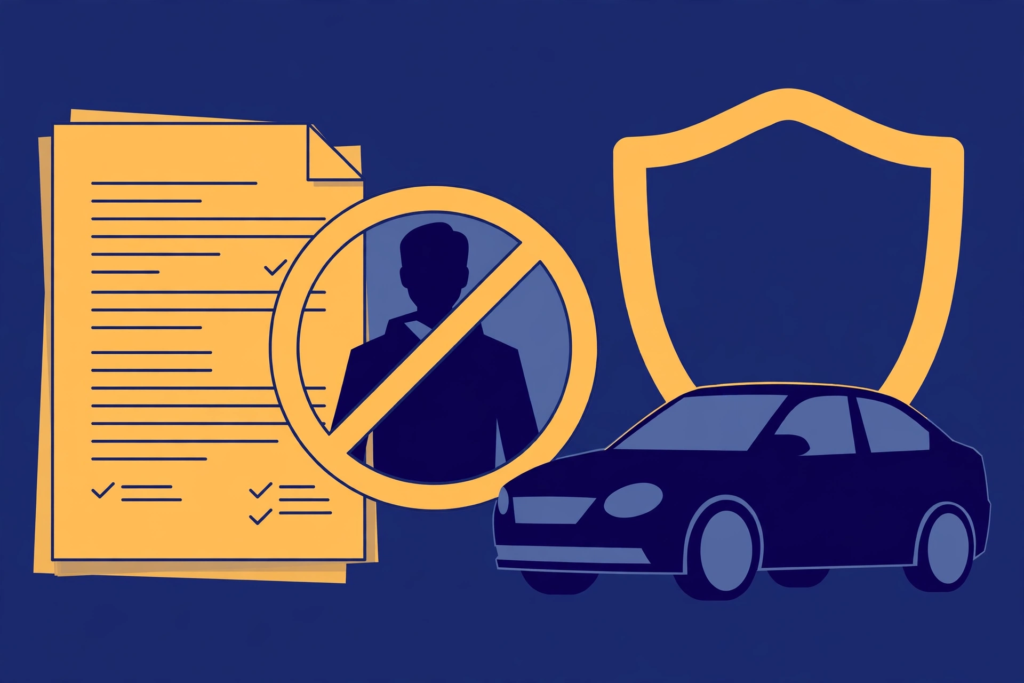
Excluded drivers car insurance provisions let a policyholder formally remove a specific person from coverage. When you sign a named driver exclusion, you agree that the policy will not cover that person under any circumstances — not for liability they cause, not for damage to your car, not even if you explicitly gave them permission to drive.
Exclusions exist for one main reason: keeping a high-risk household member off the policy so their record does not inflate everyone else’s premium. Used correctly, an exclusion can save a household significant money. Used carelessly, it can leave an accident completely uncovered. This guide explains how exclusions work, when they make sense, and the serious risks of getting them wrong.
Excluded drivers car insurance at a Glance
Excluded drivers car insurance explained: what a named driver exclusion does, when it makes sense, risks, and how to add the driver back later. Below, we break down excluded drivers car insurance in detail so you can act with confidence.
Table of Contents
What a Named Driver Exclusion Does
A named driver exclusion is a written endorsement to your auto policy identifying a specific person — by name — who is excluded from all coverage. Once signed, the exclusion means:
- The excluded person has zero coverage when driving your insured vehicles — no liability, no collision, no comprehensive, no medical payments.
- The exclusion applies even with your permission. Unlike permissive use, which requires permission, an exclusion defeats coverage regardless of what you said.
- The exclusion typically applies to all vehicles on the policy, not just one car.
- If the excluded person drives and crashes, you as the owner can be held personally liable for damages, with no insurer defending you or paying the claim.
The exclusion is absolute within the policy. There is no partial exclusion, no “only for long trips” exclusion — the person is either covered or not.
Why Households Exclude Drivers
The overwhelming reason is premium savings. Auto insurers rate a policy based on the risk of everyone who might drive the cars — and one high-risk household member can raise the entire household’s premium dramatically. Common scenarios include:
- A teen driver with violations. A young driver with an at-fault accident or speeding tickets can spike a family policy’s cost.
- A spouse or partner with a DUI. A DUI conviction affects rates for years, and excluding the driver quarantines the impact.
- A household member with a suspended license. Insurers will not cover an unlicensed driver anyway; formalizing the exclusion clarifies the record.
- A high-risk roommate or relative. Any resident driver with a poor record whose risk you do not want priced into your policy.
In each case, the household is making a calculated trade: lower premiums in exchange for the excluded person never driving the insured vehicles. The math can be compelling — but only if the “never drives” part holds.
The Risks of Excluding a Driver
An exclusion is a promise with teeth, and breaking it has severe consequences:
No coverage for the accident. If the excluded driver crashes your car, your insurer owes nothing — not to the other party, not for your car, not for injuries. You face the full financial exposure personally.
Personal liability for the owner. Accident victims can pursue your personal assets for damages the excluded driver caused while driving your vehicle. Without an insurer providing a legal defense, you pay for lawyers as well as judgments.
Policy consequences. Some insurers will non-renew a policy after an excluded-driver accident. Others may raise rates or require all household members to be listed going forward.
The “just this once” trap. Exclusions fail most often not through defiance but through convenience — the excluded teen takes the car “just to the store,” the spouse with the DUI drives because the other car is in the shop. Every exception is an uncovered accident waiting to happen.
Before signing an exclusion, every adult in the household must understand it is permanent until formally removed, not a flexible arrangement.
Exclusion Requirements and Process
Excluding a driver is a formal process with specific requirements:
- It must be in writing and signed. Verbal agreements do not create exclusions. The insurer provides a named driver exclusion form identifying the person.
- All named insureds typically must sign. If spouses are both on the policy, both generally sign the exclusion.
- The excluded person often must have other coverage. Many insurers and some states require proof that the excluded driver is insured elsewhere or does not need coverage (for example, a suspended license with no driving at all).
- State rules vary. Some states restrict or prohibit certain exclusions; others require specific disclosure language. A few states do not allow excluding a spouse. Your agent knows your state’s rules.
- It applies at renewal automatically. The exclusion carries forward each term until you actively remove it — it does not expire on its own.
Keep a copy of the signed exclusion with your policy documents, and make sure everyone in the household knows exactly who is excluded.
Alternatives to Excluding a Driver
Exclusion is not the only way to handle a high-risk household member. Consider these alternatives:
- Listing them and paying the premium. Expensive but honest — full coverage for everyone, no traps.
- A separate policy for the high-risk driver. Sometimes insuring the person on their own policy (possibly with a different company) costs less than the increase to the family policy — and keeps everyone covered.
- Usage-based or telematics programs. If the driver’s record is improving, a telematics program can demonstrate safe driving and earn discounts that shrink the surcharge over time.
- Defensive driving courses. In many states, completing an approved course earns a discount that partially offsets a violation surcharge.
- Waiting it out. Violations age off records. If the surcharge stems from an old ticket, compare the cost of listing versus excluding for the remaining time.
Run the numbers on each option before defaulting to exclusion. The cheapest compliant arrangement that keeps everyone actually covered is usually the best answer.
Removing an Exclusion
Exclusions are reversible. Common reasons to remove one: the driver’s record improved, a suspension ended, the teen gained experience and completed training, or the household simply decides the savings are not worth the risk anymore.
To remove an exclusion, contact your insurer or agent and request the change in writing. The insurer will re-underwrite with the driver listed — expect a premium increase reflecting their actual risk — and issue an updated policy without the exclusion endorsement. Do not let the person drive your cars until you have written confirmation the exclusion is removed. The gap between “we decided” and “the paperwork is done” is exactly when uncovered accidents happen.
Frequently Asked Questions
What does it mean to exclude a driver from car insurance?
It means signing a formal endorsement stating that a specific named person has no coverage under your policy — even with your permission. If they drive your car and crash, the insurer pays nothing.
Can an excluded driver ever drive my car?
They physically can, but they will have no insurance coverage whatsoever, and you as the owner face personal liability for anything they cause. The only safe answer is no.
Does excluding a driver lower my premium?
Yes — removing a high-risk driver from the rating can significantly reduce the household premium, which is the main reason families choose exclusions.
Can I exclude my spouse from my car insurance?
It depends on your state — some states prohibit spousal exclusions. Where allowed, it requires the formal signed endorsement and often proof of other coverage.
How do I add an excluded driver back to my policy?
Contact your insurer, request removal of the exclusion in writing, and complete any re-underwriting. Get written confirmation before the person drives your vehicles again.
A named driver exclusion is a powerful premium-saving tool with zero margin for error. If your household can genuinely keep the excluded person out from behind the wheel — with alternative transportation arranged and everyone committed — the savings are real. If there is any doubt, choose coverage over savings: list the driver, shop aggressively for the best price with them included, and revisit the decision as their record improves. Compare quotes with every household driver properly listed today and see the true cost before deciding whether exclusion is worth the risk.
Rules and rates change, so double-check the details of excluded drivers car insurance with the National Association of Insurance Commissioners. For more ways to save, keep reading the guides linked below.
Shopping for excluded drivers car insurance? Start by comparing quotes from at least three insurers — drivers who compare save significantly on excluded drivers car insurance every year.