
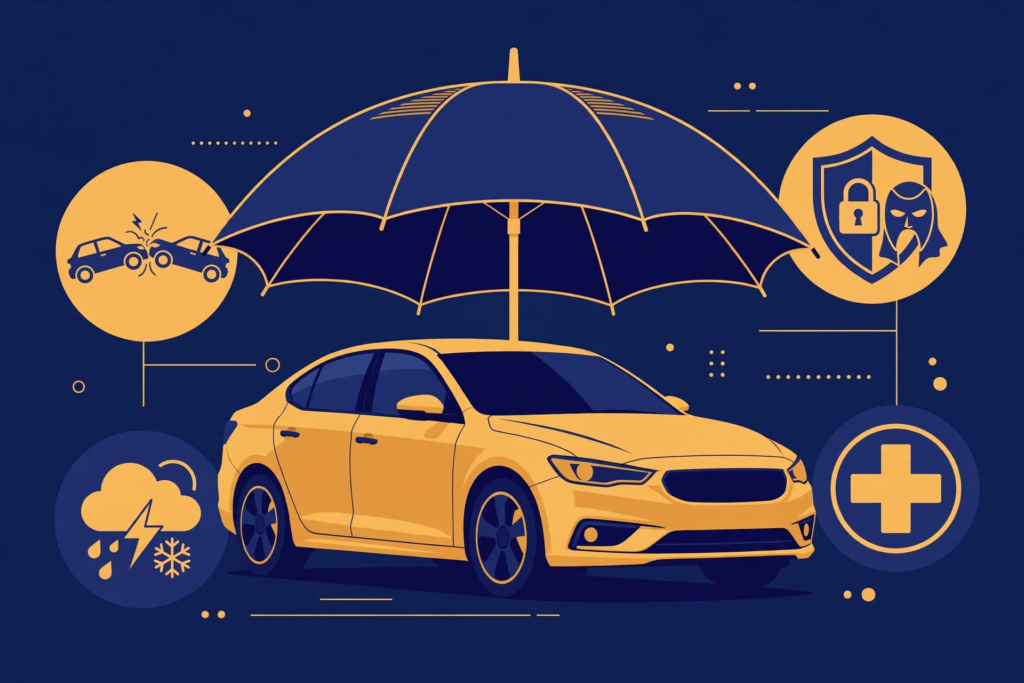
Most drivers buy car insurance, pay the bill, and hope they never need to understand it. Then an accident happens — a rear-end collision, a hailstorm, a hit-and-run — and the first question is always the same: *am I actually covered for this?* If you’ve ever wondered exactly what car insurance covers, this guide walks through every major coverage type in plain English, what triggers each one, and where the gaps hide.
Liability Coverage: Protection Against What You Cause
Bodily Injury Liability
When you cause an accident that injures someone else, bodily injury liability pays their medical expenses, rehabilitation, lost wages, and your legal defense if they sue. Limits are written as two numbers — like 100/300 — meaning $100,000 per person and $300,000 per accident. This is the coverage that protects your savings, your home equity, and your future wages from a lawsuit.
What does car insurance cover at a Glance
What does car insurance cover? A plain-English guide to liability, collision, comprehensive, PIP, UM/UIM and every coverage type in 2026. Below, we break down what does car insurance cover in detail so you can act with confidence.
Table of Contents
- What does car insurance cover at a Glance
- Liability Coverage: Protection Against What You Cause
- Collision Coverage: Your Car in a Crash
- Comprehensive Coverage: Everything That Isn’t a Collision
- Uninsured and Underinsured Motorist Coverage (UM/UIM)
- Medical Payments and Personal Injury Protection (PIP)
- Gap Insurance
- Rental Reimbursement Coverage
- Roadside Assistance and Towing
- Custom Parts and Equipment Coverage
- What Car Insurance Does NOT Cover
- Frequently Asked Questions
- The Bottom Line
Property Damage Liability
This pays to repair or replace other people’s property you damage — usually their car, but also fences, mailboxes, storefronts, and guardrails. A single number, like $100,000, caps the total per accident.
Liability is the only coverage every state (except New Hampshire) legally requires. But remember: it never pays for *your* car or *your* injuries.
Collision Coverage: Your Car in a Crash
Collision pays to repair or replace your own vehicle after a crash — whether you hit another car, a pole, a guardrail, or a pothole that destroys your suspension. It applies regardless of fault, minus your deductible.
Key facts worth knowing:
- Lenders require it on financed or leased vehicles
- Your deductible applies — you pay the first $500 or $1,000, the insurer covers the rest up to the car’s actual cash value
- It pays actual cash value, not what you paid or what you owe — depreciation is baked in
Comprehensive Coverage: Everything That Isn’t a Collision
Comprehensive handles the strange and the unlucky — damage to your car from anything other than a crash:
- Theft and break-ins
- Vandalism
- Hail, windstorms, floods, and falling trees
- Fire
- Hitting an animal (very common with deer)
- Cracked windshields from flying debris
Like collision, it’s subject to a deductible and pays actual cash value. It’s also usually inexpensive relative to the protection — many drivers keep it even after dropping collision on older cars.
Uninsured and Underinsured Motorist Coverage (UM/UIM)
Roughly one in eight U.S. drivers has no insurance at all, and many more carry only bare-minimum limits. UM/UIM steps in when:
- An uninsured driver hits you (UM)
- A hit-and-run driver can’t be identified (UM, in most states)
- An underinsured driver causes damage beyond their limits (UIM)
It can cover your medical bills, lost wages, and sometimes vehicle damage, depending on the state. Several states require it; everywhere else it’s strongly worth buying. This is the coverage that protects *you* from *other people’s* irresponsibility.
Medical Payments and Personal Injury Protection (PIP)
MedPay
Medical payments coverage pays medical bills for you and your passengers after an accident, regardless of fault. Limits are typically modest ($1,000–$10,000). It covers deductibles and copays your health insurance leaves behind, and it follows you as a pedestrian or cyclist too.
PIP
Personal Injury Protection is broader — required in no-fault states, it covers medical expenses plus lost wages and sometimes essential services like childcare while you recover. If you live in a no-fault state, PIP is mandatory and forms the backbone of your injury protection.
Gap Insurance
Cars depreciate fastest in the first couple of years. If you total a financed car while you owe more than it’s worth, collision coverage pays the car’s value — and you’re left paying the lender the difference. Gap insurance covers that difference. It’s cheap, it’s often required on leases, and anyone with a small down payment or long loan term should seriously consider it.
Rental Reimbursement Coverage
After a covered claim, you’re without a car — rental reimbursement pays for a rental while yours is repaired, up to a daily and total limit (like $30/day, $900 max). It only kicks in for covered losses, and it doesn’t apply during routine maintenance. Inexpensive and genuinely useful if you have no backup vehicle.
Roadside Assistance and Towing
This add-on covers towing, jump-starts, flat-tire changes, lockouts, and fuel delivery. Limits are modest, and many drivers duplicate it with auto club memberships or credit card benefits — check what you already have before paying for it twice.
Custom Parts and Equipment Coverage
Standard policies cover your car as it left the factory. Aftermarket wheels, stereo systems, lift kits, and custom paint need custom equipment coverage to be protected. If you’ve modified your vehicle, ask your insurer — undeclared modifications can complicate claims.
What Car Insurance Does NOT Cover
Even broad policies have exclusions worth knowing:
- Intentional damage you cause on purpose
- Commercial use — delivering food or driving for rideshare without proper endorsements
- Racing or speed contests
- Normal wear and tear and mechanical breakdowns
- Personal belongings stolen from the car (that’s renters or homeowners insurance)
- Drivers you excluded from the policy by name
Frequently Asked Questions
Does car insurance cover theft of items inside my car?
Generally no. Auto policies cover the vehicle itself; stolen laptops, bags, and phones fall under renters or homeowners insurance. Comprehensive covers break-in damage to the car, though.
Does my policy cover me when I drive someone else’s car?
Often yes, on a secondary basis — your liability typically follows you, and the car owner’s policy is usually primary. But regular use of a non-owned car can create coverage disputes, so disclose the situation to your insurer.
Will insurance pay if my car is flooded?
Yes, if you carry comprehensive coverage — flood is a classic comprehensive claim. Without comprehensive, you’re paying out of pocket.
Does car insurance cover windshield replacement?
Comprehensive covers windshield damage, often with a lower or waived deductible for glass in many states. Some states mandate zero-deductible windshield replacement.
Am I covered if an uninsured driver hits me?
Your collision coverage can repair your car, and UM/UIM covers injuries and sometimes vehicle damage. Without those coverages, you’d be chasing the at-fault driver personally — often a dead end.
The Bottom Line
Car insurance is a toolkit, not a single product: liability shields your assets, collision and comprehensive protect your car, UM/UIM guards against uninsured drivers, and add-ons like gap and rental coverage fill specific gaps. The right mix depends on your car’s value, your state’s rules, and your financial cushion. Review your coverages once a year, close the gaps that matter, and drop the ones that don’t. Compare quotes with your ideal coverage mix today — the cheapest policy is only a bargain if it covers what you actually need.
Rules and rates change, so double-check the details of what does car insurance cover with the Insurance Information Institute’s coverage guide. For more ways to save, keep reading the guides linked below.
Shopping for what does car insurance cover? Start by comparing quotes from at least three insurers — drivers who compare save significantly on what does car insurance cover every year.