Delivery driver insurance is a must-understand topic for anyone earning money with DoorDash, Instacart, Amazon Flex, Uber Eats, or similar platforms. Millions of Americans now deliver food, groceries, and packages — but many do it on a standard personal auto policy that was never designed for commercial driving. That mismatch creates dangerous coverage gaps that only become visible after an accident.
The platforms provide some insurance, but it is limited, conditional, and structured around the platform’s interests rather than yours. Understanding exactly when each layer of coverage applies — and where the holes are — is essential before you accept your next delivery.
Delivery driver insurance at a Glance
Delivery driver insurance explained for DoorDash, Instacart and gig workers: coverage gaps, endorsements, and how to stay protected on every delivery. Below, we break down delivery driver insurance in detail so you can act with confidence.
Table of Contents
Why Standard Personal Policies Fall Short
A typical personal auto policy covers commuting and personal errands. It generally excludes using your vehicle to deliver goods for hire. This is not a minor technicality: if you crash while on a delivery and your insurer determines the trip was commercial, it can deny your claim entirely.
Some drivers assume that because delivery feels casual — just dropping off groceries — it does not count as commercial use. Insurers disagree. Regularly transporting goods for pay is a business activity regardless of how informal it feels, and claim adjusters are trained to ask what you were doing when the accident happened.
Compounding the problem, many drivers never tell their insurer about their delivery work, either from oversight or fear of higher premiums. Non-disclosure can be grounds for policy rescission, which is worse than a denied claim — it can erase your coverage retroactively.
How Platform Insurance Actually Works
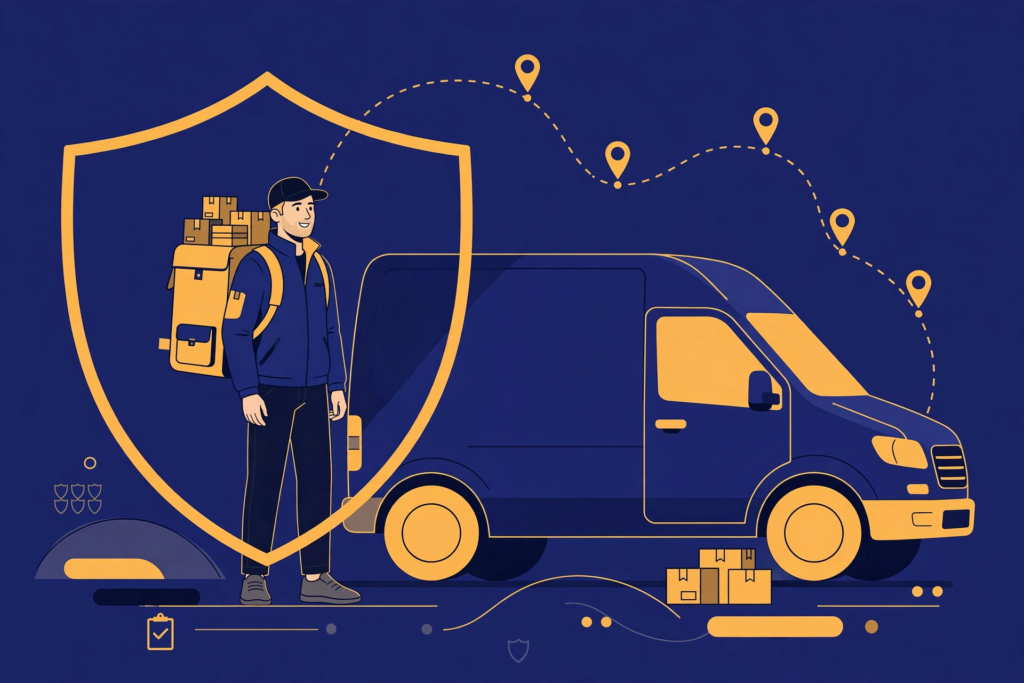
Delivery platforms generally provide commercial auto coverage, but only during specific phases of the work, and usually with significant limitations.
A typical structure looks like this:
- App off. You are on your personal policy. No platform coverage applies.
- App on, waiting for an assignment. Some platforms provide limited liability coverage during this period, but it is often much lower than standard limits, and collision coverage for your own car is usually absent.
- En route to pickup and delivering. Platforms typically provide their primary commercial liability coverage during active deliveries, often with meaningful limits. However, deductibles for damage to your own vehicle can be high, and coverage details vary by platform and state.
The gaps that matter most: the waiting period between assignments, where platform coverage is thinnest; damage to your own car, which may carry a steep deductible or no coverage at all during certain phases; and injuries to you as the driver, which platform auto policies generally do not cover — that falls to workers’ compensation rules that often do not cleanly apply to independent contractors.
Platform policies also change. Terms, limits, and deductibles are updated periodically, so the coverage summary you read when you signed up may not match today’s terms. Review the current policy documents in your driver app at least once a year.
The Coverage Gap Problem
The most dangerous gap sits in the waiting period — app on, no delivery assigned yet. During this phase you are clearly working, which can jeopardize your personal policy’s coverage, while the platform’s contingent coverage may offer only minimal liability limits and nothing for your own vehicle.
Consider a realistic scenario: you are driving to a busy restaurant district with the app on, waiting for an order. Another driver runs a red light and hits you. Your personal insurer could argue you were engaged in commercial activity and deny the claim. The platform’s waiting-period coverage might pay the other driver’s damages up to its modest limits but leave your car and your injuries uncovered. That is the gap delivery driver insurance products are designed to close.
Your Options for Closing the Gap
Delivery endorsements. An increasing number of insurers offer endorsements specifically for food and package delivery added to a personal auto policy. These endorsements extend your coverage to delivery work, typically for a modest additional premium. This is usually the simplest and most affordable solution — if your insurer offers it in your state.
Commercial auto policies. Full commercial coverage handles delivery work without ambiguity and provides higher limits. It costs more than an endorsement, but for full-time delivery drivers it is often the right choice, especially if you deliver for multiple platforms or drive high mileage.
Platform coverage alone. Relying solely on the platform’s insurance is the riskiest approach. It leaves the waiting-period gap open, may not cover your own vehicle adequately, and disappears the moment you log off — including during the drive home after your last delivery.
Non-disclosure. Continuing to deliver on a standard personal policy without telling your insurer is not a strategy — it is a gamble with your financial future. One denied claim after a serious accident can cost more than years of proper premiums.
What Delivery Driver Insurance Typically Costs
Adding a delivery endorsement to a personal policy usually increases the premium by a moderate amount — meaningful but far less than a full commercial policy. Full commercial coverage for a delivery driver costs more, reflecting the real exposure of high-mileage urban driving.
The right way to think about the cost: divide the annual increase by your expected delivery earnings. For most active drivers, proper coverage costs a small fraction of gig income and protects all of it. An uncovered accident, by contrast, can wipe out months of earnings and expose your personal assets to liability claims.
Get quotes both ways — endorsement on your current policy and standalone commercial — and compare not just price but the exact phases of work each covers. Ask specifically: “Am I covered while waiting for an assignment with the app on?”
Practical Tips for Delivery Drivers
- Tell your insurer about your delivery work before an accident forces the conversation. Ask explicitly about delivery endorsements.
- Read the platform’s current insurance summary in your driver app, noting limits and deductibles for each work phase.
- Keep delivery records. App history showing when you were online helps establish which coverage applied if a claim is disputed.
- Consider higher liability limits. Delivery means more time on the road in busy areas — the exposure is real, and state minimums are often inadequate.
- Do not forget your own injuries. Look into whether you need medical payments coverage or a separate occupational accident policy, since platform auto coverage typically does not cover driver injuries.
- Reassess if you go full-time. Occasional weekend delivery and forty hours a week are different risk profiles that may call for different products.
Frequently Asked Questions
Does DoorDash provide insurance for drivers?
Platforms generally provide commercial auto coverage during active deliveries, with more limited coverage while waiting for assignments. The details, limits, and deductibles vary by platform and state, so check the current terms in your driver app.
Will my personal car insurance cover me while delivering food?
Usually not. Most personal auto policies exclude delivery for hire. Without a delivery endorsement or commercial policy, you risk having claims denied for accidents that happen during delivery work.
What is a delivery endorsement?
It is an add-on to a personal auto policy that extends coverage to food or package delivery work. It is typically the simplest and most affordable way for part-time gig drivers to close the coverage gap.
Am I covered driving home after my last delivery?
Once you log off the app, you are back on your personal policy for the drive home — which is fine, since that is personal use. The risky period is when the app is on and you are working.
Do I need commercial insurance for Instacart or Amazon Flex?
It depends on your insurer and state. Many drivers are adequately covered with a delivery endorsement, but full-time or multi-platform drivers should compare commercial quotes too. The key is never to assume — ask your insurer directly.
Delivery driver insurance is not optional paperwork — it is the difference between a bad day and a financial catastrophe. Tell your insurer about your gig work, add the right endorsement or commercial policy, understand your platform’s coverage phases, and drive knowing every mile is actually covered. Compare quotes for delivery-friendly coverage today; the peace of mind costs far less than the gap it closes.
For official guidance on delivery driver insurance, see the National Association of Insurance Commissioners. And if this breakdown helped, the related guides below go deeper on delivery driver insurance saving strategies you can use right away.