
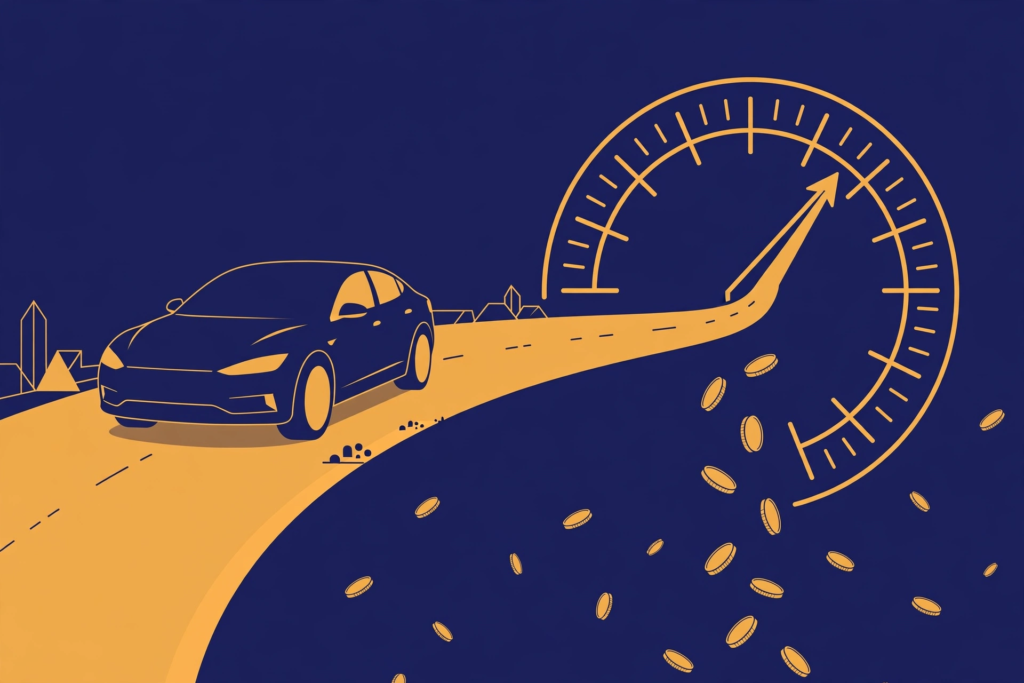
If you barely drive, why should you pay the same premium as someone commuting 50 miles a day? That is the question pay as you go car insurance answers. Instead of a flat premium based on estimated annual mileage, per-mile policies charge a small base rate plus a per-mile fee — so the less you drive, the less you pay. For the right driver, the savings are real. For the wrong one, it is an expensive mistake.
This guide explains how pay-as-you-go insurance works, weighs the pros and cons honestly, and helps you figure out whether per-mile pricing fits your life.
Pay as you go car insurance at a Glance
Pay as you go car insurance charges by the mile. Explore the pros, cons, costs, and which drivers save most with per-mile pricing. Below, we break down pay as you go car insurance in detail so you can act with confidence.
Table of Contents
How Pay-As-You-Go Car Insurance Works
The model is simple and has two parts:
1. Base rate — a flat daily or monthly charge that covers the car when it is parked (theft, weather, vandalism risk) plus the insurer’s fixed costs
2. Per-mile rate — a charge for each mile driven, typically measured by a plug-in device, a smartphone app, or your car’s built-in telematics
Your bill each month = base rate + (miles driven × per-mile rate). Drive 100 miles in a month and you pay very little beyond the base. Drive 2,000 miles and the per-mile charges add up fast.
How Mileage Is Tracked
Most pay-as-you-go insurers verify mileage through:
- Plug-in devices that connect to your car’s OBD-II port
- Smartphone apps using GPS
- Built-in connected car systems in newer vehicles
- Periodic odometer photos with some carriers
The tracking also enables the insurer to confirm the car is being driven as reported — it is the verification mechanism that makes per-mile pricing possible.
The Pros of Pay-As-You-Go Insurance
You Pay for What You Use
This is the fundamental appeal and it is genuinely fair. A retiree who drives 3,000 miles a year stops subsidizing a commuter driving 25,000. If your car spends most of its time parked, per-mile pricing aligns your premium with your actual risk exposure.
Big Savings for Low-Mileage Drivers
Drivers with very low annual mileage — remote workers, city dwellers who mostly use transit, owners of second or recreational cars — are the classic winners. The fewer miles on the odometer, the bigger the advantage over traditional flat-rate pricing.
Transparent, Controllable Costs
Every trip has a visible price. Many drivers find that seeing the per-mile cost makes them more thoughtful about unnecessary trips — combining errands, walking short distances, or taking transit. The pricing itself encourages the behavior that keeps premiums low.
No Behavioral Scoring (Usually)
Unlike behavior-based telematics programs, pure pay-per-mile insurance generally charges only for distance, not for how you brake or what time you drive. If you dislike the idea of being graded on driving style, per-mile pricing offers mileage fairness without the driving report card.
Good for Households with a Spare Car
A second car that mostly sits in the driveway is a perfect candidate. Instead of paying a full traditional premium on a rarely driven vehicle, you pay the base rate plus a trickle of per-mile charges.
The Cons of Pay-As-You-Go Insurance
Expensive for Average and High-Mileage Drivers
There is a break-even point — often somewhere in the range of average annual mileage — above which per-mile pricing costs more than a traditional policy. If you commute daily, take road trips, or just drive a typical amount, pay-as-you-go will likely punish you. This is the single most important con: the model is only cheap for genuinely low-mileage drivers.
The Base Rate Is Not Zero
Even if you drive zero miles in a month, you still pay the base rate. For a car that sits entirely unused, comprehensive-only storage coverage on a traditional policy may be cheaper than a per-mile policy’s base rate.
Tracking Is Mandatory
There is no per-mile policy without mileage verification. If you are uncomfortable with a device or app reporting your driving to your insurer, pay-as-you-go is not for you — the tracking is the product.
Fewer Carrier Choices
The per-mile market has fewer insurers than the traditional market, which means less competition and fewer options to compare. Availability also varies by state — not every per-mile carrier operates everywhere.
Coverage Options May Be Limited
Some per-mile insurers offer a narrower menu of coverage options, limits, and add-ons than large traditional carriers. If you want specialized coverages — custom equipment, accident forgiveness, extensive roadside — check availability before committing.
Billing Surprises
A month with unexpected driving — a family emergency, a road trip, a temporary long commute — produces a surprisingly large bill. Traditional premiums do not spike because you drove extra one month; per-mile bills do.
Who Should Consider Pay-As-You-Go?
Ideal Candidates
- Remote workers who drive only for errands and weekends
- Retirees with minimal driving needs
- City residents who primarily use public transit
- Second-car households where one car is rarely used
- Seasonal drivers whose car sits for months (though storage coverage may compete here)
Poor Candidates
- Daily commuters, especially long-distance ones
- Rideshare and delivery drivers — high mileage plus commercial use complications
- Road-trip enthusiasts
- Families sharing one heavily used car
- Anyone uncomfortable with mileage tracking
How to Evaluate Whether It Saves You Money
Step 1: Know Your Real Mileage
Check your odometer against last year’s records, service receipts, or your current policy’s stated mileage. Most drivers underestimate how much they drive — be honest, because the per-mile math only works with real numbers.
Step 2: Get a Per-Mile Quote
Get the base rate and per-mile rate in writing. Calculate: (base rate × 12) + (your annual miles × per-mile rate) = estimated annual cost.
Step 3: Compare Against Traditional Quotes
Get traditional quotes for the same coverage limits. Compare the totals — not the marketing. Remember that traditional quotes for low-mileage drivers already include low-mileage discounts, so the gap may be smaller than advertising suggests.
Step 4: Stress-Test the Math
Run the calculation at 25% more miles than you expect. If a moderately busier-than-usual year flips pay-as-you-go from cheaper to more expensive, the traditional policy is the safer choice.
Frequently Asked Questions
How does pay as you go car insurance work?
You pay a flat base rate plus a per-mile charge for every mile driven. Mileage is tracked via a device, app, or connected car system, and your monthly bill reflects actual miles driven.
Is pay as you go car insurance cheaper than traditional insurance?
For very low-mileage drivers, usually yes. For average or high-mileage drivers, usually no. The break-even point depends on the carrier’s rates and your driving — calculate it with your real mileage before deciding.
Do I have to install a tracking device?
In most cases, yes — some form of mileage verification is required. Options include plug-in devices, smartphone apps, or built-in telematics. Without verification, per-mile pricing cannot work.
What happens if I drive more than expected one month?
Your bill for that month is higher — you pay the per-mile rate on every mile. There is no penalty beyond the extra charges, but a heavy-driving month can be a billing shock compared to flat traditional premiums.
Can I use pay as you go insurance for a leased or financed car?
It depends on the carrier and the lender. Some per-mile insurers offer the full coverage (including collision and comprehensive) that lenders require; others have limited physical damage options. Confirm both the carrier’s offerings and your lender’s requirements.
Pay as you go car insurance is a genuinely good deal for a specific driver: low mileage, comfortable with tracking, and realistic about how little they drive. For everyone else, it is an interesting idea that costs more than the traditional policy they already have.
Compare quotes the disciplined way — real mileage, same limits, stress-tested math — and let the numbers decide. The right pricing model is the one that charges you for the driver you are, not the driver the marketing imagines.
Rules and rates change, so double-check the details of pay as you go car insurance with the Insurance Information Institute. For more ways to save, keep reading the guides linked below.